Thursday, April 22, 2010

Suzie's Thoughts on Andy Warhol and Monroe

andy_warhol_gallery_1.jpg


Andy Warhol, an amazing pop-artist, has produced many world-renown paintings and prints. His famous Elvis and Marilyn screens, Campbell’s Soup Can painting, and other pop art prints made Warhol an incredibly well-known pop culture artist and some might argue, the first. Many art historians have debated and will continue to discuss what makes Warhol's artwork so alluring and entertaining.

The article “Andy Warhol’s Silver Elvises”, by David McCarthy, explains some
major themes and motifs Warhol's pieces incorporate, such as overlapping, placement of paintings side by side, and repetition. McCarthy uses evidence like this to support his analytical claims and other critiques. McCarthy believes that the overlapping of Elvises may hint to male-to-male contact, thereby possibly indicating a homosexual theme, tying into Warhol's personal lifestyle. Other artists view the exhibition (The Ferus exhibition, which displays the numerous screen prints of Elvis) and described it as being a “musical mural” with a “rhythmic beat”, and righteously so, the screens depict of Elvis Presley, after all! While McCarthy does bring up some valid and interesting points, he lacks a sufficient evidence and opinions needed to adequately support his broad claims.

Now I know every woman over the age of sixteen is familiar with the artsy and creative portraits of the one and only Marilyn Monroe! She is one of the biggest pop culture and fashion icons in the world and like Elvis, she also inspired Warhol's artwork. In the article, titled “From Max Ernst’s Oedipus Rex, to Andy Warhol’s Marilyn Monroe”, the author, Donald Kuspit, takes on a slightly more cynical tone about Warhol’s work, to many-a-teen girl's dismay, I'm sure. Kuspit argues that pieces such as Marilyn Monroe hold no emotional value whatsoever and simply portray the superficial lives of celebrities in popular culture. Although both authors agree that Warhol’s work is extremely enticing, Kuspit believes that Warhol’s Marilyn is seductive because of her “social superficiality and complete lack of inner life” as opposed to Warhol's actual talent that he is able to convey. Kuspit goes so far as to state that Marilyn Monroe is not even a person, but rather a synthetic mannequin, molded by society with a "manufactured identity". Warhol was intrigued by pop culture and even stated that he wanted to be a star to meet other stars, so Kuspit argues that his Marilyn piece solidifies the fact that she is simply a “great synthetic product” with perfect skin and a seemingly perfect, famous life. Kuspit continues to assert that Warhol was only interested in the impression his work made, and therefore made Marilyn’s face flawless and attractive, rather than presenting the flaws that every human possesses. Even though her completely flawless face is not reality, it furthers Kuspit’s claim that Marilyn and the piece itself are both purely synthetic objects and that Warhol was fascinated by her (and other celebrities such as Elvis') artificiality. Her flawless, animated mannequin look indicates that she is a puppet on a social string. Kuspit believes that Warhol created art only with the intention to help one look good enough to be socially successful.

Both authors agree that Warhol was captivated by the lives of famous people and pop culture itself, but McCarthy discusses the techniques and themes associated with Warhol’s work, whereas Kuspit is convinced that more importantly than Warhol’s talents was his portrayal of people as synthetic figures, absent of true inner life. The second one appears to be more convincing than McCarthy’s, most seemingly because Kuspit follows his claims with more evidence and powerful opinions than McCarthy does. Although McCarthy does incorporate evidence such as themes of repetition and overlapping, Kuspit spends more time discussing the actual Marilyn piece and analyzing the perfection of her skin (among other things) in relation to Warhol and his lifestyle and interests. The further analysis by Kuspit allows the reader to better understand why Warhol possibly created the unique pieces that he did.

Wednesday, April 21, 2010

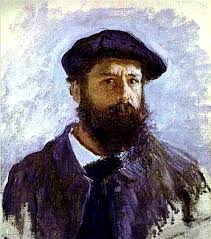
Autumn's Thoughts on Claude Monet


Claude Monet remains one of the world’s most famous and successful visual artists. His many series illustrating nature themes developed him the name” the founder of Impressionism.” Two articles by Gary Storm and Colleen Carroll explore the techniques and inspiration Monet used while painting his series.

Gary Storm argues that Monet’s theme and variations technique attracts an audience the most. Storm explains the different appeals of theme and variations using Monet’s Grainstack painting series. This technique states a main theme and then continuously varies it, while still maintaining the original theme’s quality. Each variation presents a new perspective. Storm claims that using theme and variations creates immediate beauty and pleasure through its simplistic form, order, and logic. The audience can quickly and effortlessly capture the painting’s meaning, making the painting more relatable and inviting. Storm also claims that using theme and variations creates a fusion of paradoxes that represent human thought patterns and the natural world. An interrelated patterns system holds each experience. Monet wanted his audience aware that they are related to all they study, or in his paintings’ case, nature. Two other notable motifs Monet painted include Rouen Cathedral and Waterlilies. These theme and variations “reveal the beauties to be found in the accurate observation of nature,” providing the most genuine connection.

In the second article, Colleen Carroll calls Monet “the founder of Impressionism.” Impressionism defines a painting style where the overall tone and theme’s effect grab the focus, not the details. Eúgene Boudin inspired Monet to paint his landscape pieces outdoors. Monet explains that “only the surrounding atmosphere give subjects their true value.” While spending time painting outside, Monet developed interests in the lighting effects over the course of a day. Monet’s first and perhaps the most popular series exploring lighting effects is Impression: Sunrise. The audience can see the sea and waterscape influences of Turner, where the sunset was painted. The colors shine bright and pure, the brushstrokes loose and rapid, and the painting portrays a sense of movement. Monet’s impressionistic style allowed his audience to bond with a particular theme and enjoy its various perspectives.

Concerning the lighting and color Monet used, the articles express similar opinions. Storm claims that, “Monet sought to capture the essence of light itself.” Monet’s Grainstack paintings incorporate brown, purple, gold, blue, and black. The various colors reveal lighting effects during the day and the year’s changing seasons. Monet’s brush strokes, varying in size, thickness, and texture, created “false-color”. He claimed that “so-called ‘true colors’ do not reveal, and even camouflage, subtle realities.” Carroll presents similar claims, emphasizing how Monet’s impressionistic style depended on light effects.

The most significant difference between the two articles involves Monet’s detail use. Storm claims that Monet mastered the theme and variations art form. With this technique, Monet painted many variations reflecting one theme. The minor details, such as color palates, lighting effects, shading, and texture, distinguished his variations from one another. Although Monet adjusted very minor details, each variation portrayed a different idea, feeling, and perspective. Carroll claims that Monet mastered, and even founded, Impressionism. The overall tone and theme’s effect carry the most importance, not the details. She provides evidence of a reoccurring theme of lighting effects over the course of a day. With lighting being the main theme, other details such as color, texture, and size possess little importance.

I feel that Storm’s argument includes much more evidence, making it stronger and more convincing. Although the history behind Carroll’s argument that Monet painted using an Impressionistic style contains truth, the many subtle details Monet used may have been overlooked. Storm’s evidence proves Monet obsession with details, for they were the only way he could create various paintings, involving the same subject, without being redundant and boring. His varied brushstrokes and complementary color use exemplify the details that altered the entire painting’s image. Also, Storm’s brief explanation of how Monet believed that we must be aware of how we are related to all that we study digs deeper into Monet’s overall nature theme, and how all his theme and variations are related. Overall, Storm’s immense amount of detail and evidence disputes Carroll’s argument, such as Monet disputed us being disconnected from nature.